Expanding Postsecondary Access Through Ability to Benefit (ATB)
Ability to Benefit alternatives expand adult learners' access to postsecondary education and training through the use of federal student aid.
Ability to Benefit (ATB) alternatives allow students who do not have a high school diploma or equivalency to become eligible for Title IV student assistance (federal student aid) when enrolled in an Eligible Career Pathway Program (ECPP). This co-enrollment in postsecondary education and adult education is similar to dual enrollment opportunities available to high school students, which inspired the project title, Dual Enrollment for Adult Learners (DEAL).
Students may qualify for federal student aid through one of the following ATB alternatives:
- Pass an approved ATB test (such as CELSA, ACCUPLACER, Texas Success Initiative Assessment);
- Successfully complete at least six credit hours or 225 clock hours applicable toward a degree or certificate program; or
- Participate in a State Process approved by the U.S. Secretary of Education.
Featured Resource
Dual Enrollment for Adults: A Toolkit to Support the Use of Ability to Benefit in America's Colleges was developed to help colleges, state agencies, adult education providers, and workforce development partners understand and implement Ability to Benefit opportunities.
The toolkit provides practical guidance on:
- Understanding ATB requirements
- Eligible Career Pathway Programs (ECPPs)
- ATB implementation models
- State Process development
- Cross-agency partnerships
- Student support strategies
- Promising practices from participating states and colleges
Associated Resources
OCTAE Contact
About the DEAL Project
The project was created by the U.S. Department of Education's Office of Career, Technical, and Adult Education (OCTAE) to support states in the development and implementation of ATB State Processes.
The project provided technical assistance, resources, and opportunities for collaboration to help states, colleges, adult education providers, and workforce partners expand access to postsecondary education and workforce training for adults without a high school diploma or equivalent. Lessons learned through this work have informed the development of national resources designed to support ATB implementation across the country.
Benefits of an ATB State Process
- Expanded access to career pathway programs that lead to postsecondary credentials and workforce opportunities.
- Stronger systems and supports to help adult learners succeed in accelerated dual enrollment pathways.
- Greater flexibility for institutions, which may continue using other ATB eligibility alternatives.
- Fewer delays for students in accessing federal student aid.
DEAL Technical Assistance and Project Accomplishments
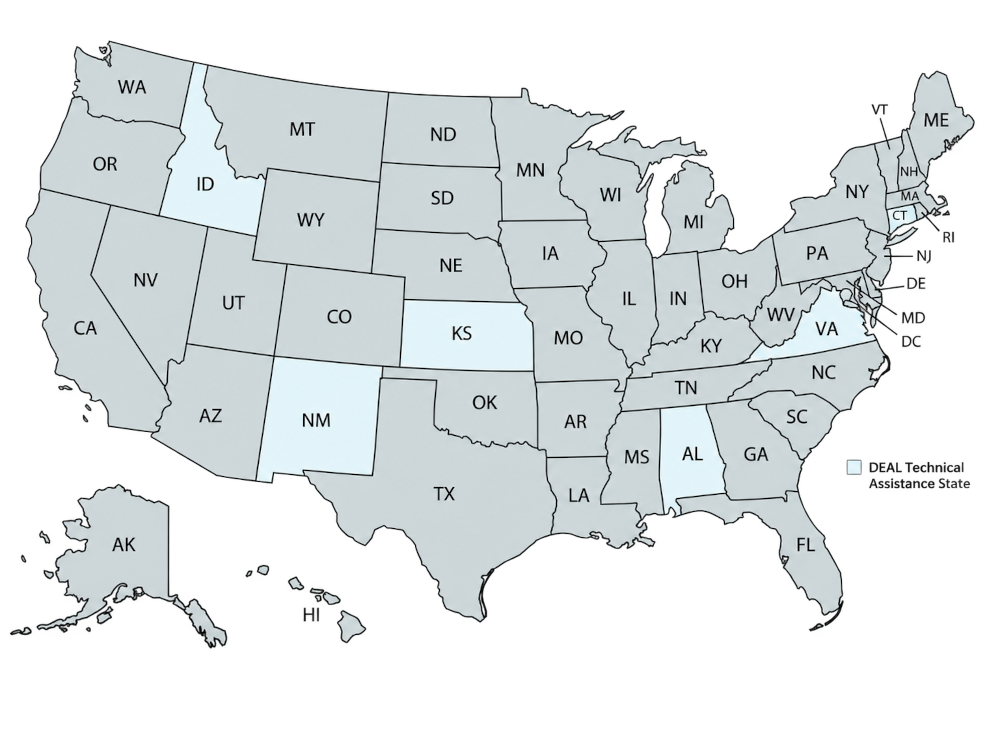
Through the DEAL initiative, six states participated in intensive technical assistance focused on exploring and implementing ATB State Processes.
Participating state teams engaged in planning, cross-agency collaboration, policy development, and implementation activities designed to strengthen pathways for adult learners. The experiences, tools, and lessons learned from this work informed the development of the toolkit and other resources for the field.
Key accomplishments of the project include:
- Increased awareness and understanding of ATB opportunities.
- Strengthened partnerships among adult education, higher education, workforce, and state agency stakeholders.
- Development of state-level strategies and implementation plans.
- Documentation of promising practices and lessons learned.
- Creation of practical resources to support colleges and states interested in expanding ATB opportunities.
Participating States
The DEAL technical assistance initiative included teams from:
- Alabama
- Connecticut
- Idaho
- Kansas
- New Mexico
- Virginia
Participating Colleges
Participating colleges included:
- Gadsden State Community College (AL)
- Lurleen B. Wallace Community College (AL)
- Connecticut State Community College (CT)
- College of Eastern Idaho (ID)
- College of Western Idaho (ID)
- Manhattan Area Technical College (KS)
- Seward County Community College (KS)
- Mesalands Community College (NM)
- University of New Mexico-Valencia (NM)
- Eastern Shore Community College (VA)
- Virginia Western Community College (VA)